




| Quantity: | |
|---|---|


Product Introduction
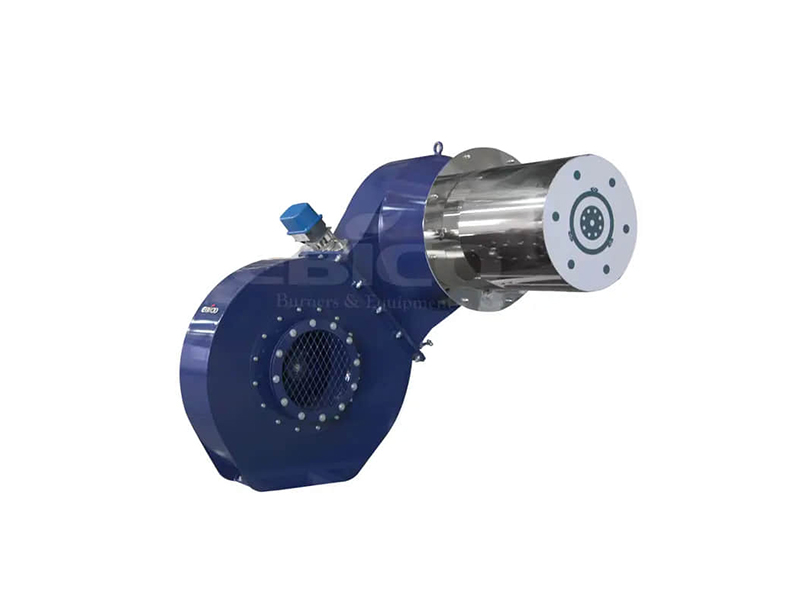
The EC-GR-VIC is designed for medium-capacity industrial boiler projects that require controlled combustion, stable heat input, and a defined NOx target. The series covers boiler capacities from 3 to 30 t/h, with a stated output range of 3,000 to 24,500 kW.
VIC combustion technology is combined with electronic proportional regulation to coordinate fuel and combustion air as boiler demand changes. The boiler burner can be configured for new installations or retrofit work, subject to the fuel, furnace geometry, boiler back pressure, control interface, and emission requirement.
The final selection is based on the boiler and site as a complete combustion system rather than boiler capacity alone.
Low-NOx combustion depends on how fuel, air, flame temperature, and residence time are managed inside the furnace. The EC-GR-VIC uses EBICO's VIC combustion concept to organize the combustion process around the required heat release and emission target.
The burner head and operating settings must be matched to the furnace. This helps avoid treating the burner as an isolated component when flame shape, furnace dimensions, heat input, and draft conditions all affect the result.
Electronic proportional control regulates combustion air and fuel input together. The control strategy is developed around the selected fuel, burner output, boiler demand, and the available control signals.
Correct commissioning remains important. Air-fuel settings should be established across the agreed operating range and checked using combustion measurements rather than a single full-load reading.
As steam or process-heat demand changes, the burner adjusts its firing input within the configured operating range. Stable response depends on coordination between the burner controller, actuators, fuel train, fan, flame supervision, and boiler control system.
Features
Dedicated for 3–30 TH Industrial Boilers
Precisely matched to EC3GR–EC10GR models, covering 3000–24,500 kW output for medium-capacity steam and thermal oil boilers.
Stable Ultra-Low NOx Without FGR
Maintains NOx < 30 mg/m³ without FGR, ensuring regulatory compliance without increasing system complexity.
Electronic Proportional Combustion Control
Real-time air–fuel ratio adjustment ensures stable flame, fast load response, and consistent steam pressure.
High Fuel Efficiency for Continuous Operation
Designed for long-term 24-hour production, delivering near-constant thermal efficiency without output attenuation.
Multi-Fuel Industrial Adaptability
Supports NG, LNG, LPG, CNG, heavy oil, light oil, and coal powder, ideal for plants with unstable or diverse fuel supplies.
Modular & Skid-Mounted Structure
Reduces installation workload, site modification, and downtime during replacements and retrofits.
Anti-Condensation & Anti-Carbon Deposition Design
Prevents low-temperature corrosion, nozzle clogging, and combustion chamber fouling, extending service life.
Technical Parameters
| Model | Output capacity (KW) | Gas consumption (Nm3/h) | Specifications of boiler (T) |
| EC3GR | 3000 | 300 | 3 |
| EC4GR | 4800 | 480 | 4/5 |
| EC5GR | 6800 | 680 | 6/8 |
| EC6GR | 9500 | 950 | 10/12 |
Application
The EC-GR Low Nitrogen Burner (3–30 TH) is designed for medium-scale industrial thermal systems where environmental compliance, fuel efficiency, and continuous operation are critical:
3–10 TH Steam Boilers – food processing plants, packaging factories, laundries
6–15 TH Industrial Boilers – textile dyeing, printing, water washing industries
10–20 TH Process Boilers – pharmaceutical production, fermentation systems
15–30 TH Heavy Industrial Boilers – chemical plants, rubber and resin production
Thermal Oil Heating Systems (8–30 TH) – asphalt mixing plants, chemical reactors
Low-NOx Boiler Retrofit Projects – emission upgrades for existing medium boilers
Industrial Parks & Centralized Heating Stations – medium-scale heat source systems
This range represents the core industrial boiler market with the highest annual operating hours and strictest emission supervision.
EBICO develops industrial burners, combustion controls, fuel and air supply systems, automation packages, and integrated thermal-energy solutions. Its Asia-Pacific headquarters is located in Wuxi, China, and its work covers both standard equipment and project-specific combustion systems.
The company describes a quality process that includes component selection, modular production, testing before delivery, and traceability for customized products. Its technical work covers safety, energy efficiency, environmental performance, and intelligent monitoring.
EBICO's service network covers more than 60 countries and regions. Project support can include operating-condition review, solution development, installation and commissioning, technical training, follow-up service, maintenance, and spare-parts support.
Selection requires the boiler type, rated capacity, required heat input, furnace dimensions, back pressure, fuel specification, supply pressure, load range, site conditions, emission target, and control interface. Boiler capacity alone is not enough.
No. The t/h value describes steam production capacity, while kW describes thermal output. Their relationship depends on steam pressure, feedwater temperature, boiler efficiency, fuel, and operating conditions.
Yes, retrofit applications can be evaluated. The existing furnace, burner opening, boiler back pressure, fuel train, controls, refractory, chimney, installation space, and shutdown plan must be checked before a retrofit proposal is prepared.
Fuel composition, furnace geometry, burner load, excess air, reference oxygen, back pressure, air temperature, altitude, commissioning settings, and the measurement method can all affect the reported NOx value.
The EC-GR-VIC is presented as capable of a below-30 mg/m³ NOx target without external FGR in suitable applications. The required performance still needs to be evaluated against the actual boiler, fuel, reference conditions, and local test method.
The wider EC-GR series lists configurations for gaseous, liquid, and pulverized-coal fuels. Each fuel requires a corresponding burner arrangement, fuel-delivery system, control strategy, and safety system. The required fuel must be specified before selection.
Both steam-boiler and thermal-oil applications can be evaluated. The burner must be selected according to the required heat input, combustion chamber, heat-transfer system, back pressure, load pattern, and process-temperature requirement.
Key checks include the burner opening, mounting interface, furnace dimensions, service space, back pressure, fuel supply, electrical supply, control signals, safety circuits, air path, chimney, and emission-measurement provisions.
Contact Us
EC-GR-VIC Burner Selection
Share your boiler, furnace, fuel, and emission data. EBICO will review the operating conditions and discuss a low-NOx burner configuration for your new installation or retrofit project.


