




| Quantity: | |
|---|---|


Product Introduction
The EBS-GNQ Series represents a new generation of intelligent combustion systems tailored for asphalt mixing facilities that require continuous operation, precise thermal balance, and dynamic fuel management.
Unlike conventional mechanical burners that depend on fixed mechanical linkages, the EBS-GNQ platform leverages digital proportional control, autonomous PLC-based regulation, and adaptive output modulation to maintain consistent process temperatures even when feed moisture or production load fluctuates.
Rather than functioning merely as a burner, the EBS-GNQ acts as a process-control component within the entire drying and heating sequence of an asphalt plant.
At the heart of the EBS-GNQ platform is a digitally driven proportional adjustment system. Fuel and combustion air are not simply delivered in fixed ratios; they are continuously analyzed, recalculated, and balanced through PLC algorithms that interpret real-time production data.
This modernized control approach provides several operational advantages:
Extremely wide modulation capability(up to 1:10), allowing the system to respond instantly to high or low thermal demands
Seamless power transition when production shifts between warm-up, steady operation, and peak load
Accurate thermal alignment that offsets inconsistent aggregate moisture or weather-related variations
Stable flame characteristics from burner ignition to long-duration full-load running
Instead of fighting production changes, the system automatically synchronizes combustion behavior with the asphalt plant’s operational rhythm, ensuring a smoother, more predictable drying curve.
Asphalt production environments are rarely stable—aggregate moisture, drum airflow, material feed rate, and ambient temperature can shift rapidly.
The EBS-GNQ responds with continuous micro-adjustments, maintaining a consistent thermal profile throughout the drying phase.
Enhanced high-precision performance translates directly into production value:
Uniform mixture quality due to fewer thermal fluctuations
Lower energy waste, as the burner avoids excessive fuel input during moisture spikes
Minimized thermal stress on mechanical parts such as the drying drum and transfer components
Improved long-term stability, allowing the plant to operate with fewer manual interventions
Precision is therefore not just an added feature—it’s a direct contributor to operational reliability, fuel savings, and asphalt quality consistency.
The EBS-GNQ platform is engineered to work with a wide spectrum of fuels, including:
Natural Gas (NG)
Liquefied Petroleum Gas (LPG)
Light Oil
Heavy Oil
Hybrid and mixed-fuel arrangements
Where traditional burners often require hardware adjustments when switching fuels, EBS-GNQ handles this through algorithm-driven compensation, allowing:
Smooth transitions between fuel types
Stable flame formation even with lower-grade or variable-viscosity fuels
Optimized combustion efficiency based on active fuel properties
Operational continuity when supply chains or price conditions shift unexpectedly
This makes the burner particularly valuable for asphalt plants in remote regions, developing markets, or areas with changing seasonal fuel access.
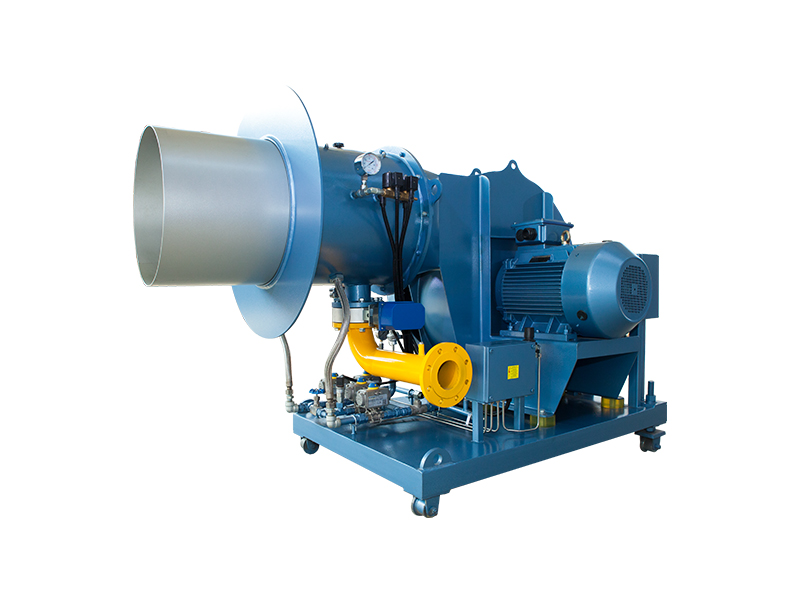
The hardware layout of the EBS-GNQ series adopts a densely packed modular structure where fuel circuits, control components, and mechanical assemblies are arranged for efficient use of space.
To enhance day-to-day handling and maintenance, the burner includes a mobile wheel-based mounting frame, allowing technicians to reposition or access the unit with minimal downtime.
Key practical advantages include:
Fast on-site alignment with the burner port
Rapid relocation between plant modules or projects
Improved maintenance comfort, enabling easier component inspection
Simplified piping and cable routing, reducing installation errors
This configuration is especially beneficial for plants prioritizing short installation timelines or frequent operational adjustments.
The EBS-GNQ employs variable-frequency fan technology, allowing the airflow delivery to match actual combustion demand rather than running at constant maximum speed. This shift significantly reduces unnecessary electrical use.
Additional energy-related benefits include:
30–40% reduction in annual fan energy consumption compared with fixed-speed systems
Higher combustion completeness, made possible by independent fuel/air computation
Approximately 2% efficiency gain through optimized oxygen flow control
Lower carbon footprint, supporting modern environmental operation standards
Over extended operation cycles—common in asphalt production—these energy savings are financially meaningful and environmentally beneficial.
The EBS-GNQ burner family is engineered to serve a full spectrum of asphalt mixing plant capacities:
500 / 1000 / 1500 / 2000 / 3000 / 4000 / 5000 / 6000
Corresponding heat outputs range from:
4150 kW → 41500 kW
This structured power ladder ensures:
Precise fit for small, mid-sized, and large continuous/batch plants
Consistent temperature control even at elevated throughput levels
Straightforward integration into new plant designs or modern retrofits
A unified burner family capable of scaling with plant growth
Rather than offering isolated models, the EBS-GNQ forms a complete, scalable combustion solution.
Technical Parameters
| Model | Output capacity (Kw) | GasConsumption (Nm3/h) | Oil Consumption (kg/h) | Specifications of the mixing plant |
| EBS350GNQ | 4150 | 415 | 370 | 500 |
| EBS600GNQ | 7100 | 710 | 630 | 1000 |
| EBS900GNQ | 10600 | 1060 | 950 | 1500 |
| EBS1200GNQ | 14200 | 1420 | 1270 | 2000 |
| EBS1800GNQ | 21300 | 2130 | 1900 | 3000 |
| EBS2500GNQ | 27800 | 2780 | 2490 | 4000 |
| EBS3000GNQ | 35500 | 3550 | 3180 | 5000 |
| EBS3500GNQ | 41500 | 4150 | 3710 | 6000 |


