
Views: 0 Author: Site Editor Publish Time: 2026-11-26 Origin: Site


Upgrading industrial or commercial heating systems requires moving beyond manufacturer "nameplate" ratings. You must demand verifiable field performance instead of relying on glossy brochures. Facility managers need solid proof. Capital expenditure on new combustion equipment represents a major investment for any organization. You can only justify this expense if you prove operational expenditure reductions. Empirical data makes this possible. Without exact measurements, you risk overpaying for systems running below their promised efficiency.
We will define the exact combustion analysis metrics needed to validate these systems. You will understand the testing conditions and equipment capabilities required for accurate assessment. This guide prepares you to validate the true performance of a new heating system prior to final procurement or commissioning. It gives you the technical framework to ensure your investment delivers genuine, measurable savings.
True efficiency is validated through a combination of low excess air (O2), minimal carbon monoxide (CO), and optimized stack temperatures.
Upgrading to an electronic proportional burner offers measurable improvements in fuel-to-air ratio precision compared to traditional mechanical linkage systems.
An energy efficient boiler burner must demonstrate consistent efficiency across its entire firing range (turndown ratio), not just at peak load.
Accurate measurement requires professional combustion analyzers and baseline testing to establish a verifiable Total Cost of Ownership (TCO) model.
Procurement decisions often rely heavily on theoretical maximum efficiency. We call these figures nameplate ratings. However, nameplate ratings reflect ideal laboratory conditions. Your facility operates under dynamic, seasonal loads. We must differentiate between lab results and actual operating efficiency. Boilers rarely run under perfect conditions. They face shifting weather, varying production demands, and aging infrastructure. Real-world validation remains the only way to measure actual fuel consumption.
Minor deviations in combustion efficiency matter immensely. They translate directly into significant annual fuel waste. A drop of just two percent can cost facilities thousands of extra dollars over a single year. Your lifecycle costs rise rapidly without precise, ongoing measurement. Operational budgets suffer when unseen inefficiencies force equipment to burn excess natural gas or fuel oil just to meet basic steam or hot water loads.
Defining success criteria clearly prevents these financial losses. A successful retrofit requires a guaranteed fuel reduction percentage. It demands sustained emission compliance under local regulations. It also needs specific return-on-investment timelines. You must build your procurement strategy around these verifiable numbers. Buyers should stipulate exact performance benchmarks in their contracts. This ensures vendors remain accountable for the actual operating expenses their equipment generates over its lifespan.
Finding a true High Efficiency Burner requires understanding specific chemical and thermal metrics. These indicators tell the real story behind fuel consumption and energy waste.
Every combustion process needs extra air to operate safely. We call this excess air. It ensures complete ignition. It prevents dangerous buildups of explosive gases inside the chamber. However, excess air carries a steep thermal cost. It absorbs valuable heat and carries it out the exhaust stack. You are essentially paying to heat ambient boiler room air instead of your process water.
Technicians target optimized oxygen levels during tuning. Gas systems typically aim for 2% to 3% oxygen in the exhaust. Pushing O2 levels lower increases thermal efficiency significantly. Yet, you must avoid producing unburned combustibles. Finding this exact balance dictates your overall fuel savings. A skilled technician walks a tightrope. They must minimize excess air without starving the flame of necessary oxygen.
Carbon monoxide serves as the primary indicator of incomplete combustion. High CO means unburned fuel is escaping. You waste money when fuel fails to ignite fully. It represents unreleased British Thermal Units (BTUs) floating away. Technicians monitor CO closely to find the operational floor of excess air.
Lowering excess air eventually causes carbon monoxide spikes. This threshold wastes fuel and violates environmental standards. It also creates severe safety hazards inside the boiler room. A well-tuned system keeps CO emissions close to zero. They should rarely exceed 50 parts per million during normal operation. If you see CO levels rising, the system is begging for more oxygen or a burner head adjustment.
Net stack temperature calculates the difference between ambient room air and exiting flue gases. It measures how effectively the boiler absorbs heat. For example, if ambient air is 80°F and gross stack temperature is 300°F, your net stack temperature is 220°F.
A lower stack temperature confirms excellent heat transfer. It proves heat enters the process fluid rather than escaping outside. High stack temperatures often indicate fouled heat exchanger tubes. They might also signal excess air carrying heat away rapidly. Tracking this metric confirms your equipment utilizes the fuel efficiently. Routine cleaning and precise burner tuning keep this vital metric in check.
Combustion Metric Guidelines for Gas Burners
Metric | Target Range (Natural Gas) | What High Values Indicate | What Low Values Indicate |
|---|---|---|---|
Oxygen (O2) | 2.0% - 3.0% | High heat loss, excessive air, fuel waste. | Incomplete combustion, soot risk. |
Carbon Monoxide (CO) | 0 - 50 ppm | Incomplete combustion, safety hazard. | Clean, efficient burn process. |
Net Stack Temp | 50°F - 100°F above fluid temp | Poor heat transfer, fouled tubes. | Condensation risk (if non-condensing). |
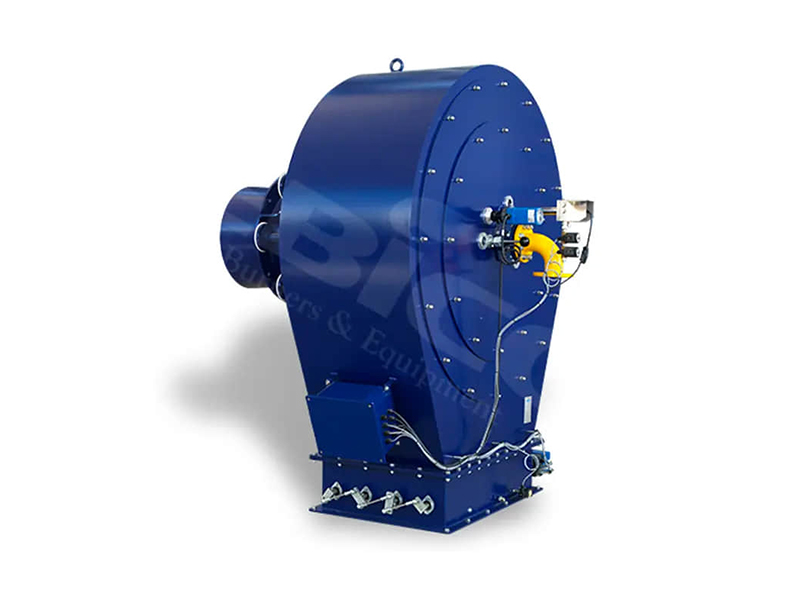
Mechanical linkages dominate older boiler rooms. These traditional single-servo setups rely on physical rods, jackshafts, and cams. They drive both the fuel valve and the air damper simultaneously. They suffer from inherent hysteresis, often called "slop." Physical wear degrades their accuracy over time. Vibrations loosen set screws. Bearings wear out.
This physical wear forces technicians into conservative tuning. They deliberately add extra air to prevent rich conditions as linkages drift. This guarantees baseline inefficiency. You sacrifice fuel economy just to maintain safe operation between annual tune-ups.
You overcome this limitation with modern digital controls. Independent servo motors drive the fuel and air valves separately. They maintain precise stoichiometric ratios across the entire firing curve. Upgrading to an Electronic Proportional Burner eliminates mechanical drift entirely. Microprocessors monitor and adjust these ratios instantly based on programmed combustion curves.
You achieve highly repeatable efficiency. You also reduce thermal shock on the boiler vessel. The system responds to load changes much faster without overshooting. These measurable outcomes easily prove the return on investment for electronic controls. They offer a level of precision that mechanical systems physically cannot achieve.
Purchasing an Energy Efficient Boiler Burner solves only half the problem. You must test and commission it properly in the field. Laboratory numbers mean nothing if the equipment falters in your actual boiler room.
You cannot measure improvement without a starting point. Record baseline data on your existing equipment. Do this long before installing or tuning the new hardware. Document daily fuel consumption, load profiles, and current emissions output. Measure feedwater temperatures and track steam output accurately. This baseline provides the empirical proof needed to validate the upgrade. Without it, you operate on guesswork.
Lab tests ignore the chaotic nature of boiler rooms. Field testing must account for shifting environmental variables. Draft fluctuations change how air enters the combustion chamber. Ambient temperature shifts alter air density drastically from morning to night. Barometric pressure variations affect oxygen availability during storm fronts.
These elements skew basic measurements. You must test the system under actual load conditions. Avoid isolated test-stand scenarios. Force the system to respond to genuine process demands. Real-world validation guarantees real-world performance under all weather conditions.
Accurate measurement demands professional tools. Technicians require calibrated, industry-standard digital combustion analyzers. These devices measure oxygen, carbon monoxide, nitrogen oxides, and temperature simultaneously. They calculate complex efficiency algorithms instantly.
Annual calibration of these tools ensures data integrity. Outdated analog tools cannot provide the resolution needed for high-efficiency tuning. Insist that commissioning agents provide printed or digital logs directly from their analyzers. This prevents human error in transcription.
Choosing the right equipment requires strict evaluation criteria. Do not accept vague marketing claims. Focus on verifiable data points that guarantee long-term operational savings.
Turndown Ratio Verification: Turndown ratio defines how low a system can fire before shutting off. A 10:1 ratio means the system can run at 10% capacity smoothly. Buyers must demand performance data across the entire spectrum. Review metrics at low fire, high fire, and transitional stages. True high-efficiency models maintain optimal oxygen and CO ratios throughout the turndown range. Poorly designed systems lose their efficiency the moment they leave peak load. They suffer from rapid cycling losses.
Transparency and Guarantees: Maintain a skeptical view of vendor claims. Demand contractual performance guarantees based on independent field testing. Reject estimates based entirely on theoretical laboratory data. Vendors confident in their equipment will readily sign performance-based contracts. If they refuse to guarantee post-installation field metrics, look for another supplier.
Maintenance and Lifecycle Stability: Efficiency degrades quickly if equipment requires constant attention. Assess how frequently the system needs re-tuning. Ask vendors about predictive maintenance diagnostics. Modern systems track servo positioning and alert operators before efficiency drops.
When comparing proposals, use this specific criteria list:
Does the vendor guarantee specific O2 and CO parameters at 25%, 50%, 75%, and 100% load?
Does the system use independent, microprocessor-controlled servo motors?
Are post-installation baseline audits included in the commissioning cost?
What is the demonstrated turndown ratio without increasing excess air beyond 5%?
Does the control system integrate easily with existing building management systems for continuous monitoring?
Confirming equipment efficiency remains a strictly data-driven process. It requires evaluating specific metrics like optimal oxygen levels, minimal carbon monoxide production, and reduced stack temperatures. It also demands embracing precise control technologies like independent servo motors. You cannot rely on outdated mechanical linkages if you want measurable savings.
Facility managers must take decisive action to protect their operational budgets. Require a comprehensive combustion audit before starting any system upgrade. Demand measurable performance thresholds in your formal Request for Proposal. You secure long-term operational savings by relying on verifiable field data rather than hopeful estimates. Make data your primary tool for procurement.
A: Best practices dictate at least annual combustion testing. However, facilities with high operational hours or extreme seasonal temperature shifts may require bi-annual tuning. Frequent measurement maintains peak efficiency and prevents slow mechanical drift from wasting fuel.
A: While specific to the boiler design and operating pressure, a general rule of thumb is a net stack temperature of 50°F to 100°F above the operating temperature of the medium being heated. Anything higher indicates wasted heat.
A: It eliminates physical linkages that wear and drift over time. It uses microprocessors and independent servos to deliver exact fuel-to-air ratios at every point of the firing rate, preventing the need for inefficient, air-rich tuning.
A: Yes. Optimized combustion reduces overall fuel consumption, which lowers your total carbon footprint. It also tightly controls O2/fuel ratios, which is absolutely critical for maintaining Low NOx and low CO emission compliance.


