
Views: 0 Author: Site Editor Publish Time: 2026-11-23 Origin: Site


Facility managers and plant engineers know a hard truth about industrial thermal systems. Investing heavily in premium capital equipment for thermal efficiency only yields a solid return if you strictly maintain combustion chemistry.
Every combustion process naturally requires a necessary baseline of excess air to ensure complete fuel burnout and maintain operational safety. However, the everyday operational reality often strays far from this baseline, revealing that excessive excess air quietly erodes the return on investment of advanced equipment. It continuously acts as an invisible, relentless drain on your facility's fuel resources.
Mitigating this excess air is not just a routine maintenance task to delegate or ignore. It serves as a primary evaluation criterion when selecting, evaluating, and retrofitting modern combustion control systems. In this guide, you will learn the exact mechanisms of heat loss, evaluate operational impacts, and discover how modern digital controls lock in peak thermal efficiency.
Excess air acts as a thermal sponge, absorbing combustion heat and carrying it out the exhaust stack, directly increasing fuel consumption.
Drift in legacy mechanical linkages is a leading cause of unintended excess air; upgrading to an Electronic Proportional Burner eliminates this mechanical hysteresis.
When evaluating an Energy Efficient Boiler Burner, mandate integrated O2 trim and high turndown ratios to maintain precise air-to-fuel ratios across all firing rates.
Achieving strict EPA compliance and emissions reduction (NOx/CO) requires verifiable, continuous air ratio management, not just point-in-time tuning.
Plant managers often view excess air purely as a theoretical physics issue. We must fundamentally reframe it as a direct operational expense leak. When you pump unnecessary air into the combustion chamber, you waste expensive fuel. You spend real money heating useless gas instead of generating steam or hot water for your process.
Let us examine the exact mechanism of this heat loss. Ambient air consists of roughly 79% nitrogen and 21% oxygen. Nitrogen does not burn. It plays no active, beneficial role in generating heat. The physics are unforgiving. Unreacted oxygen and excess nitrogen simply act as thermal sponges inside the furnace.
They absorb intense heat meant for the boiler tubes.
They expand and accelerate through the boiler passes.
They carry valuable thermal energy straight out the exhaust stack.
We can easily track this energy loss. Elevated stack temperatures strongly correlate with continuous efficiency degradation. As a standard engineering rule, you experience a 1% efficiency loss for every 40°F rise in stack temperature. Every single cubic foot of unneeded air steals heat from your product.
Many facilities buy premium hardware and assume they have permanently solved their efficiency problems. They believe a High Efficiency Burner inherently guarantees optimal performance. This represents a highly dangerous operational misconception.
The hardware alone cannot maintain perfection without continuous air-to-fuel ratio oversight. A state-of-the-art firing head still obeys the laws of chemistry. If operators neglect this critical ratio, the system defaults to safe but highly inefficient parameters. It will run safely, but it will not run economically. You must actively manage the combustion chemistry to realize the equipment's true potential.
The physics of heat loss quickly translate into measurable financial and compliance burdens. We must trace these variables to understand their true operational impact.
Operating at 30% or higher excess air creates an exponential cost curve. We typically target a strictly controlled 10-15% excess air range for natural gas firing. Pushing beyond this optimal target burns significantly more fuel to reach the exact same thermal output. You essentially pay your utility provider to heat the neighborhood sky instead of your industrial process. Over a year of continuous operation, this seemingly small leak devours thousands of dollars in wasted natural gas.
Environmental compliance adds another complex layer of scrutiny. Excess air physically cools the primary flame. This cooling effect might temporarily seem beneficial for lowering certain thermal readings, but it drastically increases the total volume of flue gases. Pushing larger exhaust volumes complicates your ability to meet strict EPA emission limits.
You must constantly walk a regulatory tightrope. Too little air generates deadly carbon monoxide (CO) and unburned hydrocarbons. Conversely, too much air forces the combustion blower to work much harder. This alters the flame geometry and risks triggering severe nitrogen oxide (NOx) penalties.
Beyond wasted fuel and emission fines, unchecked air actively ruins expensive capital equipment. Pumping unnecessary air volumes pushes blower motors well past their intended duty cycles. This drastically increases mechanical wear and tear on bearings, belts, and impellers.
Furthermore, excess oxygen in the hot flue gas poses severe, long-term corrosion risks. It reacts aggressively with sulfur traces found in certain fuels. This reaction artificially lowers the acid dew point of the exhaust gas. This specific phenomenon causes highly destructive acid dew point corrosion in economizers, breeching structures, and stack liners.
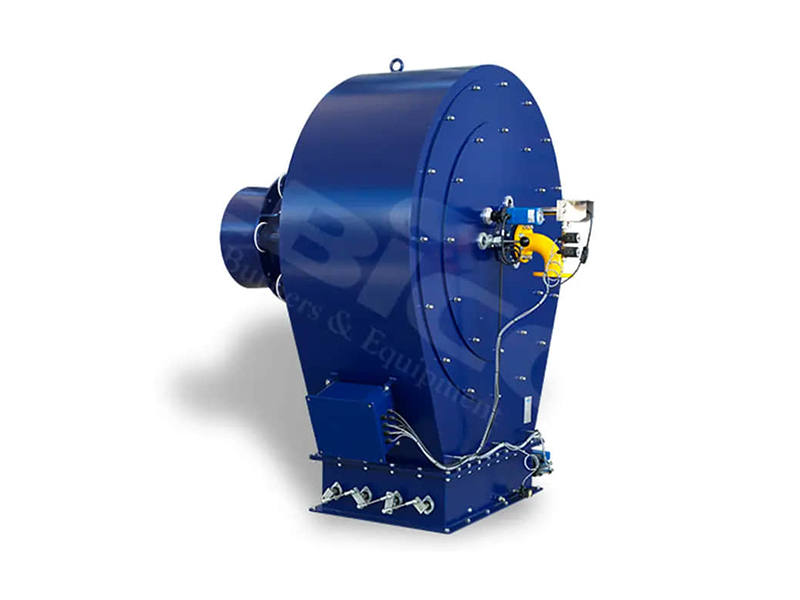
Solving the excess air problem requires examining how we mechanically deliver fuel and air into the furnace. The control methodology dictates the efficiency ceiling.
Traditional single-point mechanical linkage systems dominate older boiler rooms. In these legacy setups, a single motor drives both the fuel valve and the air damper through physical rods, jackshafts, and cams. These systems inevitably drift over time. They suffer from continuous wear, ambient temperature changes, and constant structural vibration.
This physical degradation creates mechanical hysteresis. It leads operators to tune the system deliberately "air-rich." They do this to prevent sudden soot formation or dangerous CO spikes during rapid load changes. They willingly sacrifice efficiency to guarantee safety. It creates a setup that remains stable but becomes notoriously expensive to operate.
Modernizing the plant requires moving away from physical cams entirely. The industry now firmly embraces the Electronic Proportional Burner as the definitive technical solution. This advanced technology completely eliminates mechanical hysteresis. It physically removes the restrictive rods and linkages connecting your fuel and air controls.
Digital systems utilize independent, high-precision servomotors for the fuel valve and the air damper. A digital microprocessor expertly governs these separate motors. It rigidly locks in the exact air-to-fuel ratio across the entire firing curve.
If the system modulates down to a low firing load, the microprocessor independently adjusts the servos with micro-step precision. You get highly repeatable, pinpoint accuracy every single time the system fires. The digital controller never suffers from physical wear or linkage slop.
Upgrading your equipment requires careful, methodical evaluation. When you assess an Energy Efficient Boiler Burner, you must rigorously map its technical features to your required business outcomes. Look for specific capabilities that actively protect your operational budget.
First, evaluate O2 Trim Systems. Does the proposed system continuously monitor stack gases? An effective setup uses a zirconium oxide exhaust probe to auto-correct air dampers for ambient temperature or barometric changes in real-time. This closes the control loop effectively.
Second, examine the Turndown Ratio. High turndown ratios are absolutely critical. Can the unit maintain tight air-to-fuel ratios at very low operational loads? Excellent turndown capability drastically reduces wasteful short-cycling. Every time a boiler cycles off and performs a pre-purge, it blows valuable, pre-heated air straight out the stack.
Third, mandate VFD (Variable Frequency Drive) Integration. Does the control package dynamically modulate the blower motor speed? Slowing the fan during low-fire states saves massive amounts of electrical energy alongside the combustion fuel. The fan affinity laws dictate that even a small reduction in fan speed yields a massive drop in electrical consumption.
Table 1: Combustion Control Technology Comparison
Feature | Legacy Mechanical Linkage | Electronic Proportional Control |
|---|---|---|
Actuation Method | Single motor with physical rods and cams | Independent servomotors governed digitally |
Hysteresis Risk | High (wear, vibration, temperature drift) | Zero (digital positioning removes physical slop) |
Air-to-Fuel Precision | Low (requires tuning for worst-case air density) | Very High (programmable curve matching) |
Turndown Capability | Typically limited to 3:1 or 4:1 | Often reaches 10:1 without losing stability |
Standalone hardware provides limited long-term value. You must assess compatibility with existing Plant Management Systems like BMS or SCADA. Transparent data logging allows for true predictive maintenance. Operators can monitor historical excess air trends from a central control room. They can flag subtle anomalies before they compound into major efficiency losses.
Planning the installation requires as much rigor as selecting the hardware. You cannot simply plug in industrial combustion equipment and expect perfection.
Buying premium hardware does not automatically equal premium performance. We call this the commissioning fallacy. Advanced digital controls do not replace the strict need for precise initial combustion tuning. Certified technicians must meticulously map the combustion curve during the initial installation. They must set the electronic profiles using freshly calibrated flue gas analyzers. If they program bad baseline data into the digital controller, the system will execute that bad data flawlessly.
Atmospheric conditions constantly change, and your setup must reflect this physical reality. Seasonal temperature swings drastically affect air density. Cold winter air is incredibly dense and highly oxygen-rich. Hot summer air is thin and contains significantly less oxygen per cubic foot.
Baseline setups need to account for these worst-case atmospheric conditions if an auto-trim system isn't installed. Without dynamic, continuous adjustment, tuning a boiler perfectly for a freezing winter day can easily cause a summer operation to run fuel-rich, unstable, and highly dangerous.
Before committing to a comprehensive equipment overhaul, follow a structured evaluation logic. Audit your current system thoroughly.
Conduct a Combustion Analysis: Hire professionals to measure baseline excess oxygen, carbon monoxide, and stack temperatures across multiple firing rates.
Assess Mechanical Wear: Inspect existing linkages, dampers, and blower motors for physical degradation or hysteresis.
Calculate Fuel Waste: Use the stack temperature and O2 data to quantify your exact current operational efficiency.
Build the Financial Case: Project the precise fuel and electrical savings a digital retrofit will deliver against the upfront capital expenditure.
The core reality remains clear. The absolute performance ceiling of a highly rated combustion system is fundamentally capped by the precision of its air control. You cannot bypass the strict laws of thermodynamics. Excess air remains a relentless, invisible thief of your thermal energy.
Demand total performance transparency from OEMs during the purchasing process. Remind your buyers to rigorously ask for guaranteed efficiency curves at minimum load, not just at optimal full-load conditions. Real-world operations rarely sit at 100% capacity all day. You need performance that scales perfectly across all loads.
Stop guessing about your operational leaks. Schedule a comprehensive baseline combustion audit today. Request a customized return-on-investment calculation to justify your next retrofitting project and secure massive, long-term energy savings for your facility.
A: Typically, we target 10% to 15% excess air for natural gas applications. This target translates to roughly 2% to 3% oxygen measured in the flue gas. However, this exact baseline varies based on specific equipment design, fuel composition, and operational load requirements.
A: A standard industry heuristic states that every 15% increase in excess air decreases overall boiler efficiency by roughly 1%. Over a year of continuous operation, this seemingly small efficiency drop easily adds up to thousands of dollars in wasted fuel.
A: No. O2 trim dynamically adjusts air dampers for changing ambient conditions and minor drift. However, annual or semi-annual mechanical inspections and comprehensive baseline calibrations remain strictly required. Technicians must verify safety limits and ensure optimal physical function.


