

Views: 0 Author: Site Editor Publish Time: 2026-08-25 Origin: Site
Stricter environmental regulations routinely force facilities to upgrade their industrial combustion systems. You now face a critical CapEx and OpEx decision regarding emission control technology. Facility managers must constantly balance immediate compliance mandates against long-term operational costs. A standard Low NOx Burner effectively reduces baseline emissions through staged combustion techniques. However, achieving sub-30 ppm or sub-9 ppm limits presents a tougher engineering challenge. These strict thresholds often force engineers to evaluate Flue Gas Recirculation (FGR). You must compare traditional FGR systems against newer, non-FGR alternatives.
This comprehensive guide breaks down the operational realities and distinct compliance triggers. We uncover the hidden costs of recirculation systems to aid your procurement strategy. You will learn how fuel types and boiler geometry heavily influence this choice. This evaluation helps facility managers and engineers determine exactly when FGR is required. Ultimately, we reveal when you must leverage FGR and when you can safely avoid it.
Compliance dictates the baseline: Standard Low NOx burners typically require FGR to consistently hit sub-30 ppm and sub-9 ppm NOx thresholds, particularly on older boiler retrofits.
FGR carries ongoing OpEx penalties: Induced draft fans for FGR increase electrical loads, maintenance cycles, and system footprint.
Technology is shifting: Advanced Ultra Low Emission Burner designs (e.g., premix surface combustion) can now achieve single-digit NOx without external FGR, shifting the evaluation from "Can we do it?" to "Which architecture offers the best lifetime ROI?"
Flue Gas Recirculation relies on a very straightforward core mechanism. The system re-routes a portion of the exhaust gas back into the primary combustion zone. Most industrial setups recycle anywhere from 15 to 30 percent of the total exhaust volume. A dedicated ducting network captures this gas directly from the boiler stack. A forced draft fan then injects it back into the burner windbox.
The science behind this process eliminates fluff and focuses on direct thermal chemistry. FGR acts as a highly effective thermal diluent during the combustion cycle. Exhaust gases contain large amounts of carbon dioxide and water vapor. These inert gases possess high specific heat capacities. They absorb excess thermal energy and lower the peak flame temperature. Furthermore, injecting exhaust gas reduces the overall oxygen concentration in the combustion zone. Both lower temperatures and reduced oxygen directly inhibit the formation of thermal NOx.
You must distinguish between standard staged-combustion burners and ultra-low emission systems. Standard burners delay the mixing of fuel and air to lower temperatures. They often meet moderate compliance limits without needing external recirculation. However, systems pushing the absolute lowest emission boundaries operate differently. They historically rely on heavy FGR application to suppress stubborn NOx formation.
Specific objective criteria frequently force a facility into utilizing FGR technology. You cannot always choose your preferred burner architecture based purely on preference. Engineering realities dictate strict operational dependencies. The following factors determine when external recirculation becomes an absolute necessity.
Strict Regulatory Thresholds: Regional compliance metrics increasingly dictate burner design choices. Some local air quality districts mandate sub-9 ppm limits for industrial emissions. Standard staged combustion simply cannot achieve these aggressive targets alone. For many conventional burner designs, FGR remains the only proven method to guarantee compliance.
Fuel Source Constraints: Your available fuel type heavily dictates FGR dependency. Natural gas behaves entirely differently than heavy liquid fuels during combustion. Liquid fuels, like #2 heating oil, contain chemically bound nitrogen. Combusting liquid fuels generates both thermal NOx and fuel-bound NOx. FGR becomes structurally required to suppress these complex emission profiles.
Legacy Boiler Retrofits: Engineers frequently face challenges fitting modern burners into older boiler furnaces. Legacy boilers often feature high heat-release rates and compact furnace volumes. These tight geometric dimensions naturally create intense, concentrated flame temperatures. FGR compensates for inadequate furnace dimensions by artificially forcing cooler flame temperatures. This protects aging boiler tubes from severe flame impingement.
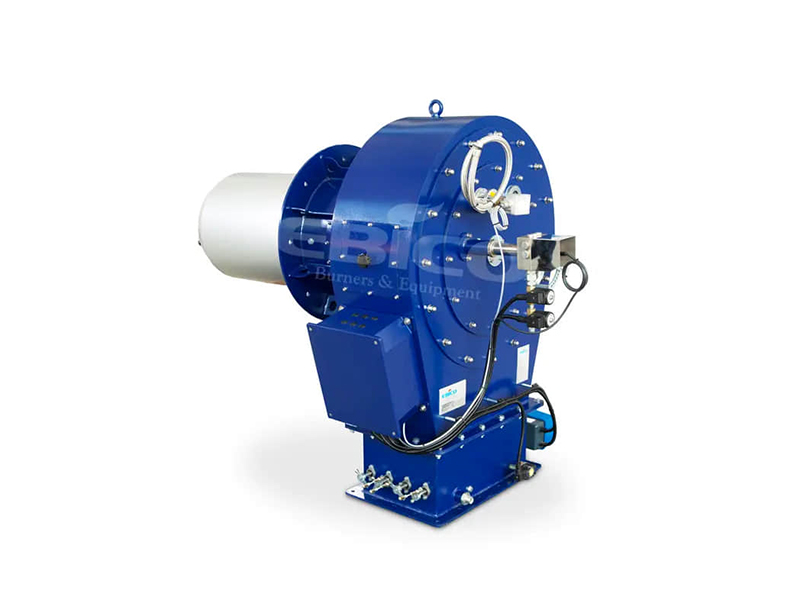
FGR systems introduce significant operational friction into your boiler room. You must account for the long-term realities of running these complex setups. The most immediate impact involves a substantially increased continuous electrical load. FGR requires a much larger forced draft fan to operate effectively. In some designs, engineers install a completely dedicated FGR blower. These fans must push dense, heavy flue gas through extensive ductwork. This significantly increases continuous electrical consumption over the entire equipment lifespan. It represents a permanent increase in your facility OpEx.
Combustion stability and turndown ratio also suffer under heavy recirculation. Injecting inert exhaust gas naturally narrows the safe flammability limit of your fuel. High-FGR systems often experience drastically reduced turndown ratios. They require highly rigorous tuning protocols to maintain a stable flame profile. Improper tuning quickly leads to severe flame instability. It can also cause acoustic resonance, which creates dangerous rumbling vibrations inside the boiler.
Finally, facility managers must consider the physical maintenance and footprint realities. The extra equipment requires massive external ductwork and specialized high-temperature insulation. You must maintain additional control dampers and mechanical linkages. Fan impellers suffer significantly increased wear and tear over time. They handle hot, moisture-laden, and potentially corrosive exhaust gases continuously. This harsh environment accelerates metal degradation and forces more frequent maintenance shutdowns.
The industrial combustion sector is currently experiencing a massive non-FGR shift. Next-generation Low Nitrogen Boiler Burner technologies increasingly bypass external recirculation entirely. Leading solutions include high-swirl premix burners and surface-stabilized fiber mesh designs. These modern architectures achieve strict environmental compliance through vastly different thermodynamic mechanisms.
These advanced burners rely on rapid mixing and massive surface-area combustion. Premix systems combine air and fuel completely before they reach the burner head. Surface combustion technologies then spread this mixture across a woven metal fiber matrix. The flame burns cleanly across a broad, uniform surface rather than a single intense point. This mechanism keeps flame temperatures uniformly low across the entire firing zone. It entirely prevents thermal NOx formation without requiring any external gas recirculation.
We must maintain a balanced perspective when evaluating these non-FGR trade-offs. Non-FGR burners successfully eliminate bulky external ductwork and save tremendous fan energy. However, they demand much stricter air-to-fuel ratio controls to operate safely. They also require highly filtered combustion air. Even minor dust intake can quickly clog the delicate surface combustion mesh. Furthermore, these advanced engineered systems typically carry a higher initial unit cost.
Table 1: Comparing FGR and Non-FGR Burner Architectures
Burner Feature | Traditional FGR Systems | Advanced Non-FGR Systems |
|---|---|---|
Mechanism | Thermal dilution via exhaust recycling | Premix and uniform surface combustion |
Electrical Load | High (requires larger fan motors) | Low (standard fan requirements) |
Space Requirement | Large footprint for external ductwork | Compact footprint (no ductwork needed) |
Turndown Ratio | Often limited by flame stability | Typically wider and more stable |
Air Filtration Needs | Standard industrial filtration | Strict filtration required for mesh protection |
Procurement and engineering teams need a highly structured evaluation logic. Selecting the correct architecture impacts your operational budget for decades. Follow these four core steps to choose the optimal burner design.
Map the Compliance Roadmap: Determine your exact emission targets first. Are you targeting 30 ppm for current basic compliance? Perhaps you need sub-9 ppm to future-proof the facility against upcoming legislation. Strict future-proofing often justifies investing in an advanced Ultra Low Emission Burner.
Assess Spatial and Infrastructure Limits: Carefully evaluate your physical boiler room environment. Does the room have adequate physical clearance for bulky FGR ductwork? You must also verify your electrical panels. Check if the existing electrical infrastructure can safely support larger fan motors.
CapEx vs. OpEx Modeling: Contrast the initial capital expenses against ongoing operational costs. Traditional FGR systems usually offer a lower upfront equipment cost. However, you must weigh this against the lifetime energy savings of a non-FGR system. Reduced maintenance cycles on non-FGR units heavily impact long-term budgets.
Boiler Compatibility Auditing: Never guess on furnace geometry. We strongly recommend engaging a qualified combustion engineer. They must accurately calculate the furnace heat release rate. Non-FGR burners require highly specific geometric clearances. Proper auditing prevents devastating flame impingement on your boiler water tubes.
Flue Gas Recirculation remains a highly reliable method for achieving strict emission compliance. It consistently lowers thermal NOx in heavy industrial applications. However, FGR is no longer your only viable engineering option. Technological advancements now provide compelling alternatives that bypass recirculation entirely. You must weigh physical constraints against long-term operational costs.
Facilities should generally default to FGR when retrofitting dimensionally constrained older boilers. It remains a practical choice if you operate on a strict CapEx budget. Conversely, you should seriously evaluate non-FGR architectures if you prioritize long-term savings. Minimizing your electrical footprint and reducing maintenance downtime strongly justify advanced premix systems.
We advise all facility operators to prioritize professional system evaluations. Request a site-specific combustion audit before you finalize any equipment specifications. Conduct a rigorous life-cycle cost analysis to expose hidden operational penalties. Expert guidance ensures you choose the most efficient, compliant burner architecture for your facility.
A: FGR does not directly destroy thermal efficiency. However, the increased mass flow can slightly elevate your stack exhaust temperatures. This causes minor heat loss. Additionally, the continuous electrical cost of running the large blower negatively impacts overall plant efficiency.
A: The industry standard typically demands a 20% to 30% recirculation rate. Hitting sub-9 ppm relies heavily on optimal burner geometry. It also depends strictly on consistent fuel composition and maintaining precise excess air levels.
A: Yes, you can retrofit existing setups, but it carries engineering risks. It requires modifying the main blower and adding extensive ductwork. You must upgrade the burner management system (BMS). Engineers must also re-evaluate the flame shape to ensure it will not impinge on boiler tubes.
