

Views: 0 Author: Site Editor Publish Time: 2026-08-06 Origin: Site
Are you risking your facility's operational continuity on a single energy source? Transitioning to modern combustion systems represents a strategic necessity for risk management and energy cost control. It is much more than a simple mechanical upgrade. Single-fuel reliance exposes industrial plants and institutional facilities to severe vulnerabilities. You face potential supply chain disruptions, unpredictable localized grid failures, and highly volatile spot-market pricing.
A successful integration requires careful planning and precise execution. You must achieve seamless fuel switchovers to maintain uninterrupted production. You also need to meet increasingly stringent local NOx emission standards to avoid regulatory fines. Furthermore, you must maintain highly accurate air-to-fuel ratios across varying load demands. All this must happen without sacrificing your boiler's overall thermal efficiency. Read on to discover the core engineering parameters, compliance benchmarks, and implementation strategies necessary for upgrading your industrial steam or hot water heating systems.
Dual fuel setups (typically natural gas paired with #2 oil or propane) provide critical N+1 redundancy, allowing continuous operation during primary fuel interruptions.
Procurement specifications must mandate specific turndown ratios (e.g., 8:1 on gas) and oxygen trim controls to ensure operational flexibility and fuel economy.
Compliance-focused upgrades require integrating Flue Gas Recirculation (FGR) to achieve sub-30 ppm or ultra-low NOx (<9 ppm) targets.
Switchover protocols dictate system quality: industry standards for critical facilities require a single operator to complete fuel transition in under 20 minutes without manual pipe alterations.
Critical infrastructure requires continuous steam and hot water generation. Hospitals, food processing plants, and chemical manufacturing facilities simply cannot afford unplanned downtime. This operational resilience relies heavily on the N+1 redundancy standard. The N+1 standard dictates your system possesses one independent backup component ready to deploy instantly. In thermal generation, this ensures you meet maximum demand even if a primary utility pipeline fails completely. By installing a robust dual fuel burner, you secure a highly reliable backup plan for facility operations.
Financial flexibility also drives the transition away from single-fuel setups. You can practice active fuel price arbitrage. Market prices for natural gas and secondary liquid fuels fluctuate based on seasonal demand. Tariff structures often change depending on peak usage hours or interruptible service contracts. Switching fuels seamlessly allows you to optimize energy expenses. When natural gas prices spike during extreme winter freezes, your facility can pivot to stored fuel oil. This agility protects your operational profit margins.
Furthermore, external supply grids remain vulnerable to extreme weather events and geopolitical shifts. Facility managers must establish strong supply chain safeguards to ensure continuity. Industry guidelines strongly recommend keeping adequate on-site backup fuel reserves. Maintaining 10 to 15 days of storage for peak winter months effectively mitigates external supply grid vulnerabilities. It provides enough buffer time to weather extended utility outages without halting production lines.
Selecting the right equipment requires precise engineering and careful mathematical modeling. The burner input energy must precisely match your boiler heat capacity requirements. Extreme oversizing creates immediate operational nightmares. Engineers should keep capacity tolerance within a strict ±5% to ±10% margin. This tight tolerance prevents rapid cycling, extends equipment lifespan, and maintains consistent steam pressure.
Load stability depends heavily on selecting appropriate turndown ratios. Base-load operations, running at a constant high output, often tolerate a standard 4:1 turndown ratio very well. However, fluctuating loads behave entirely differently. Batch manufacturing processes require much higher flexibility. You need an 8:1 or even 10:1 ratio here. A high turndown ratio prevents the equipment from short-cycling. Every time a unit restarts, safety codes require a pre-purge cycle. This cycle blows cold air through the furnace, pushing valuable heat out the exhaust stack. High turndown minimizes these costly pre-purge heat losses.
You must also carefully evaluate atomization technologies for your liquid back-up fuels. You typically choose between mechanical atomization and steam or air atomization.
Mechanical atomization: Relies purely on high fluid pressure to break up the oil. It is simpler but offers limited turndown capabilities.
Steam or air atomization: Utilizes steam expansion or compressed air to shear the liquid into a fine mist. It yields much smaller droplets. This results in cleaner combustion and less carbon buildup inside the furnace.
Finally, environmental conditions impact sizing calculations directly. Engineers must apply specific correction factors (CF) during the selection process. High altitude significantly decreases air density. High ambient temperatures produce the exact same effect. Because there is less oxygen per cubic foot of air, you require a higher rated input capacity to achieve your target actual output under these conditions.
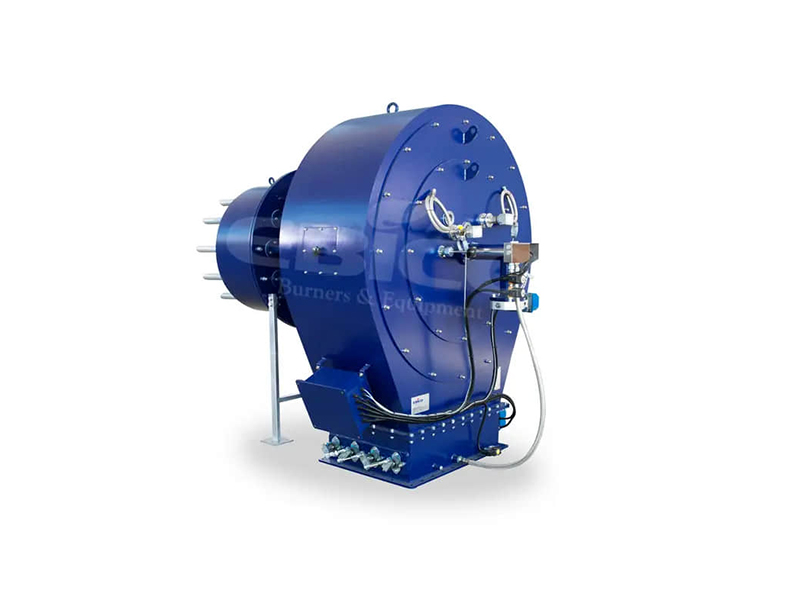
Modern facilities must address thermal NOx emissions aggressively. Advanced combustion technologies help you meet increasingly strict regulatory targets. Many regions now require sub-30 ppm or even ultra-low NOx levels below 9 ppm to secure operating permits.
How do you achieve these ultra-low emission targets? Internal Flue Gas Recirculation (FGR) plays a massive role in emission reduction. The system extracts a portion of the exhaust gas and pipes it back into the combustion zone. This inert gas absorbs heat but does not burn. Staged combustion also helps significantly by introducing fuel and air in distinct zones. Both methods lower peak flame temperatures effectively. This halts thermal NOx formation at its molecular source.
Active O2 trim systems boost your daily combustion efficiency. An oxygen trim module acts as a relentless, automated supervisor. It continuously measures stack oxygen levels using specialized sensors. It then automatically adjusts forced draft fan speeds or air dampers to maintain the perfect mixture. The return on investment becomes clear very quickly. You waste roughly 1% of your total fuel budget for every 1% of excess O2 above optimal levels.
We highly advocate for linkageless control systems on all modern upgrades. Older mechanical linkages use steel rods and cams to connect fuel valves and air dampers. Over time, these physical parts wear down. They develop mechanical play known as hysteresis. Linkageless electronic modulation replaces these rods with independent, high-precision servo motors. They combine perfectly alongside Variable Frequency Drives (VFDs) on blower motors. This modern setup eliminates mechanical hysteresis completely, improves repeatability, and drastically reduces electrical consumption at partial loads.
Safe boiler room operations demand rigorous hardware configurations and fail-safe protocols. Your Boiler Burner system requires hardwired switch interlocks to prevent catastrophic fuel mixing. The Building Management System (BMS) or primary flame controller must verify all safety steps automatically. It must confirm appropriate purge cycles and proper primary valve closures. Only after verifying these conditions should it introduce the secondary fuel into the firing head.
Transition efficiency defines top-tier industrial systems. We establish strict benchmarks for switchover speed and operator ergonomics. Facilities should require zero manual pipe modifications during a fuel switch. Operators should never need heavy lifting equipment or specialized wrenches to transition from gas to oil.
Industry standards for critical facilities dictate a strict time limit. A single operator must execute the entire fuel changeover in under 20 minutes. Some highly advanced control systems even enable automated hot swapping capabilities. You can switch fuels seamlessly without fully shutting down the boiler, preserving system pressure and temperature.
Component certification remains absolutely non-negotiable. Ensure all integrated gas train components and valve assemblies meet strict compliance codes. Specify UL (Underwriters Laboratories), IRI (Industrial Risk Insurers), and CSD-1 compliance in your procurement documents. Meeting these codes prevents fuel pooling risks, satisfies industrial insurance providers, and ensures smooth safety inspections.
Your existing boiler architecture heavily impacts burner selection. Firetube and watertube designs present very different integration challenges and physical constraints.
Design Feature | Firetube Boilers | Watertube Boilers |
|---|---|---|
Initial Thermal Response | Fast initial response due to large water volume. | Handles significantly higher capacities and rapid secondary load shifts. |
Physical Space Constraints | Strict space limits for combustion heads. Requires compact geometries. | Spacious furnace area, but requires highly precise flame shaping. |
Tube Impingement Risk | Generally lower risk if properly centered. | High risk of tube failure if the flame shape strikes the waterwalls. |
Firetube boilers offer fast initial thermal response and are very popular in commercial settings. However, they pose unique physical space constraints for combustion heads. You cannot easily fit a massive, complex FGR housing onto a standard firetube front door. Watertube boilers handle higher pressures and larger capacities effortlessly. Yet, they require precise flame shaping. If the flame geometry is incorrect, the fire will impinge directly on the water tubes, causing rapid metal fatigue and eventual rupture.
Tying modern equipment into older infrastructure carries significant project risks. You often face major BMS integration challenges during retrofits. Modern microprocessor-based dual fuel controls use digital signals. Legacy boilers often rely on pneumatic logic or basic analog relays. Connecting these two worlds requires specialized signal converters and careful input/output mapping. You need skilled integration technicians to bridge this communication gap safely.
Proper commissioning guarantees long-term operational success. Do not leave the startup phase to chance. Procurement contracts must explicitly mandate the following requirements:
Factory-authorized performance testing: Ensure technicians verify safety limits and hardwired interlocks before handing over the keys.
Custom air-to-fuel curve mapping: Technicians must tune the system using exhaust gas analyzers. They should build a smooth combustion curve across low, medium, and high fire ranges.
Documented operator training sessions: Your facility staff must receive hands-on classroom and field training to understand fault codes and switchover procedures.
A successful equipment integration depends on a balanced evaluation framework. Facility managers must weigh upfront capital costs against the long-term fuel savings achieved via optimal O2 control. You must secure operational insurance through redundant fuel supplies to protect against unpredictable utility outages. Furthermore, your equipment selection must ensure strict adherence to constantly shifting emissions legislation to avoid operational penalties.
Do not rush blindly into the procurement phase. We recommend initiating your upgrade process via an independent combustion audit. You must calculate current facility load profiles precisely to determine your true turndown requirements. Once you gather this empirical data, you can confidently issue a detailed Request for Proposal (RFP) that guarantees a highly resilient, compliant, and efficient thermal system.
A: Modern systems execute the fuel switch in under 20 minutes. Advanced setups utilize electronic controls and hardwired interlocks. These allow operators to transition safely, sometimes automatically, without requiring any manual piping changes, valve swapping, or heavy tools.
A: Higher turndown ratios, such as 8:1, allow the unit to operate efficiently at extremely low demand without shutting off completely. This prevents short-cycling. It saves substantial fuel otherwise wasted during constant pre-purge and post-purge ventilation cycles.
A: Standard units mix fuel and air simultaneously at the head, creating high peak flame temperatures. Low-NOx systems utilize Flue Gas Recirculation (FGR) or staged combustion to reduce these peak temperatures. This significantly lowers harmful nitrogen oxide emissions.
A: A Variable Frequency Drive (VFD) is highly recommended. It actively adjusts the motor speed to match exact load requirements. This drastic reduction in fan speed cuts electrical costs significantly and enables much more precise air-to-fuel ratio control.
